

AI Document Assistant for Medical Management
Tired of wasting time and resources indexing, summarizing, and reviewing incoming medical documents?
Meet DataCare IDATM — Intelligent Document Assistant — DataCare’s AI-powered solution for medical document indexing, clinical summaries, document summaries, and utilization review medical record review support.
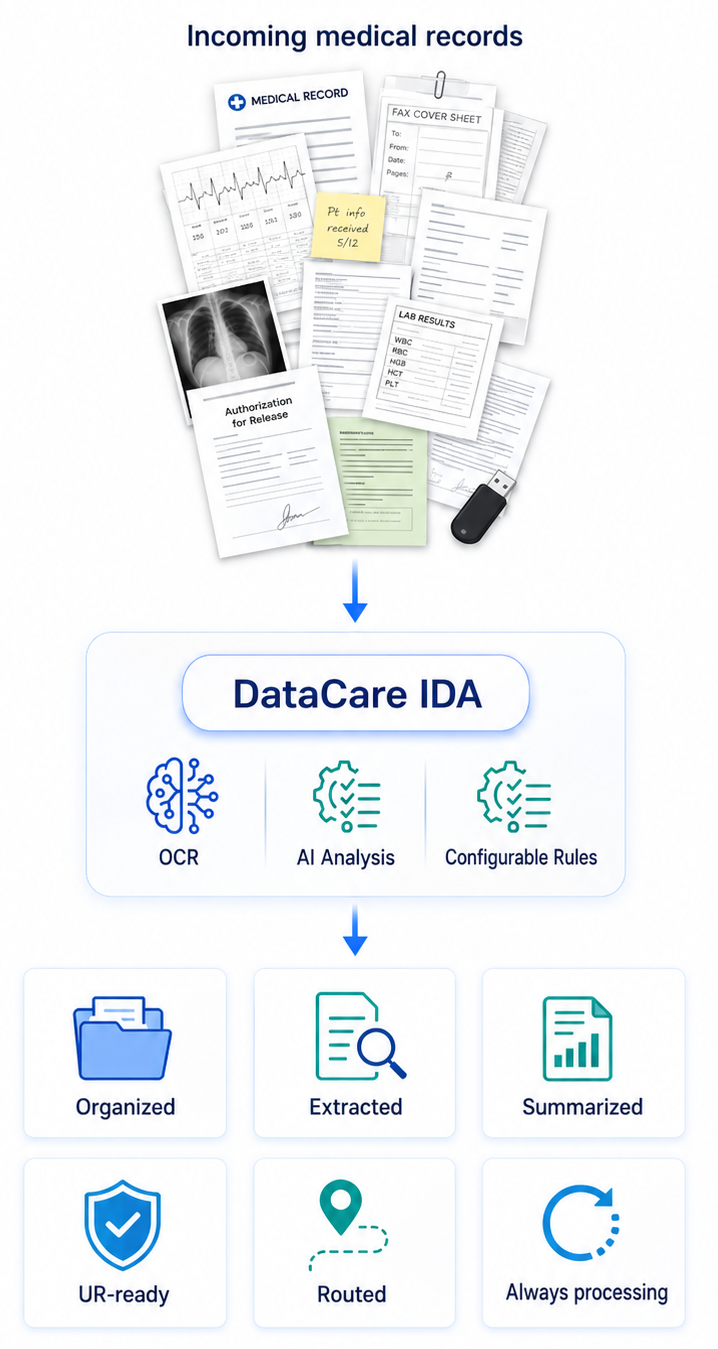
IDA helps healthcare and medical management organizations turn incoming records into structured, actionable information. Whether documents arrive by fax, email, API, FTP, or scanned PDF, IDA helps classify records, extract key details, route documents, and summarize clinical information so your team can work faster with greater consistency.
Built with deep experience in workers’ compensation, case management, and utilization review, IDA is especially well suited for organizations managing high-volume, compliance-sensitive medical workflows.
Stop digging through documents. Start acting on them.
Smarter Medical Document Management, Simplified
IDA is designed to solve the most time-consuming and error-prone challenges in medical document processing.
Medical management teams do not just need documents stored. They need documents understood, categorized, routed, summarized, and connected to the right claim, case, review, or workflow.
IDA helps teams:
- Automatically organize documents: Sort incoming correspondence — emails, faxes, scanned PDFs, and electronic files — into configured document categories and workflows.
- Extract key information: Capture important details such as claim numbers, dates of service, providers, document types, and descriptions.
- Summarize medical records: Generate concise document summaries and clinical summaries so users can understand what a record contains faster.
- Support utilization review preparation: Organize relevant medical record information into structured summaries for UR nurses and peer reviewers.
- Streamline workflows: Route documents to the appropriate claim, case file, review queue, or team.
- Operate 24/7: Help reduce documentation backlogs by processing documents beyond normal business hours.
By replacing repetitive manual steps with intelligent automation, IDA helps improve efficiency, reduce operational bottlenecks, and give clinical and administrative users faster access to the information they need.
More Than Indexing: A Medical Document Assistant
AI-Powered Document Indexing
IDA analyzes incoming documents and helps identify the correct claim, document category, description, date of service, provider, and other key fields. Documents that meet configured confidence and business-rule thresholds can be indexed automatically. Documents that need human review are routed to an indexing queue where staff can confirm or edit the suggested values.
Document Summaries
IDA generates summaries for medical and non-medical documents so users can quickly understand what a document contains without manually reviewing every page first.
Clinical Report Summaries
For medical reports, IDA can generate clinical summaries that help nurses and reviewers identify relevant findings, treatment history, diagnostics, work status, restrictions, and other case details.
UR Medical Record Review Support
IDA can help prepare structured medical record review content for utilization review workflows by organizing relevant clinical information into a consistent format. This can include clinical chronology, evidence relevant to medical necessity, diagnostics, pain scale information, work status, functional restrictions, prior procedures, comorbidities, medication risk, and other review-relevant details. IDA is designed to keep outputs concise, factual, and source-grounded — supporting review preparation without making recommendations or replacing clinical judgment.
How Accurate is AI Document Indexing with IDA?
IDA combines AI automation with configurable workflow controls and human oversight. Its ability to analyze, classify, extract, and summarize document information helps teams process medical records faster while maintaining control over sensitive or low-confidence items.
One key feature of IDA is its ability to route specific document types or low-confidence results for manual review based on configurable rules. That means your organization can decide where automation is appropriate and where human confirmation is required.
IDA supports two operating modes:
Semi-automated Mode
IDA pre-fills key indexing fields, suggests document classifications, generates document descriptions, and allows staff to confirm or edit the result. This helps reduce manual data entry while keeping users in control.
Fully Automated Mode
IDA automatically indexes documents that meet configured rules and confidence thresholds. Exceptions are sent to a review queue so staff can focus on the items that need attention.
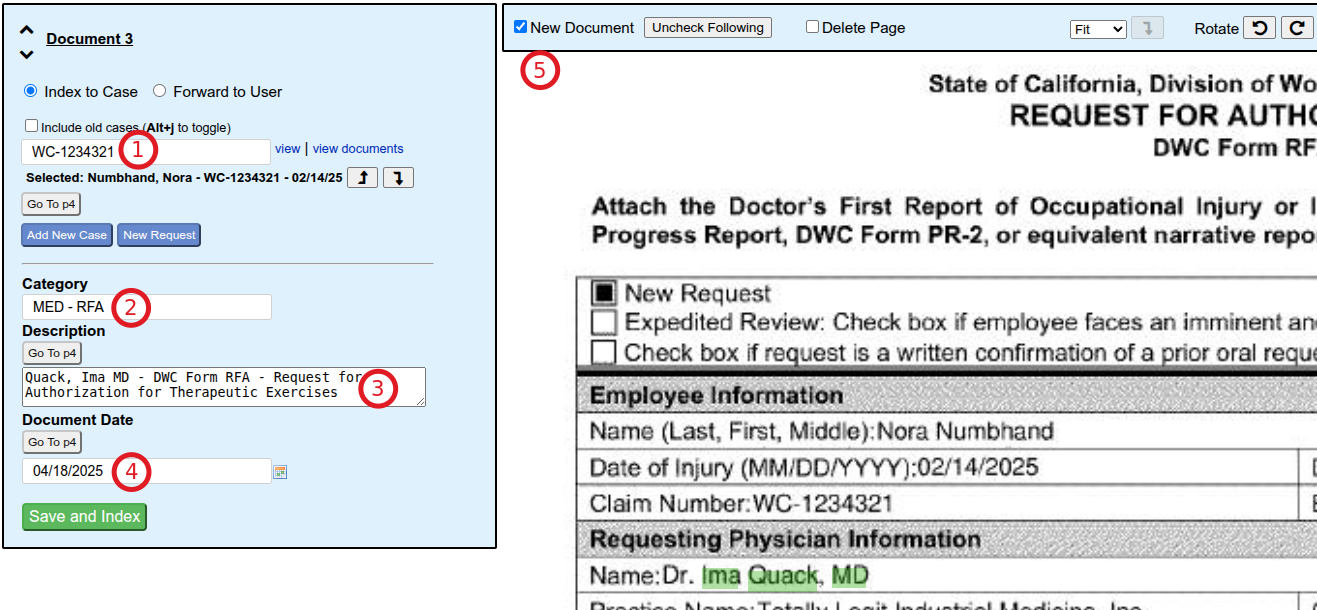
Fields 1–5 automatically populated by IDA.
This hybrid approach gives teams the benefits of automation without removing oversight from workflows where accuracy, compliance, and clinical context matter.
Built for Medical Management — Especially Workers’ Compensation
IDA is not a generic document tool. It is built for medical management organizations that depend on fast, accurate handling of medical records and claim-related documents.
That includes:
- Case management organizations
- Utilization review organizations
- Peer review networks
- Managed care organizations
- Workers’ compensation insurers
- Third-party administrators
- Self-insured employers
- Healthcare organizations with high-volume medical document workflows
IDA is especially valuable in workers’ compensation environments, where document volume, turnaround time, clinical documentation, state-specific requirements, and audit readiness all matter.
Whether your team is managing routine document intake or complex, high-volume medical record workflows, IDA helps turn incoming records into organized, usable information.
How IDA Helped One Client Improve Indexing Efficiency
For high-volume medical management teams, document indexing can become a major operational bottleneck.
One DataCare customer indexes approximately 25,000 pages per month. Using IDA, the customer reduced indexing time by more than 50% and 25% faster document indexing turnaround time.
IDA helps organizations improve efficiency by:
- Reducing repetitive manual indexing
- Pre-filling key document fields
- Automatically routing documents when confidence is high
- Sending exceptions to review queues
- Generating summaries that help users understand records faster
- Supporting downstream case management and utilization review workflows
The result is faster document processing, reduced backlog risk, and a more scalable medical document workflow.
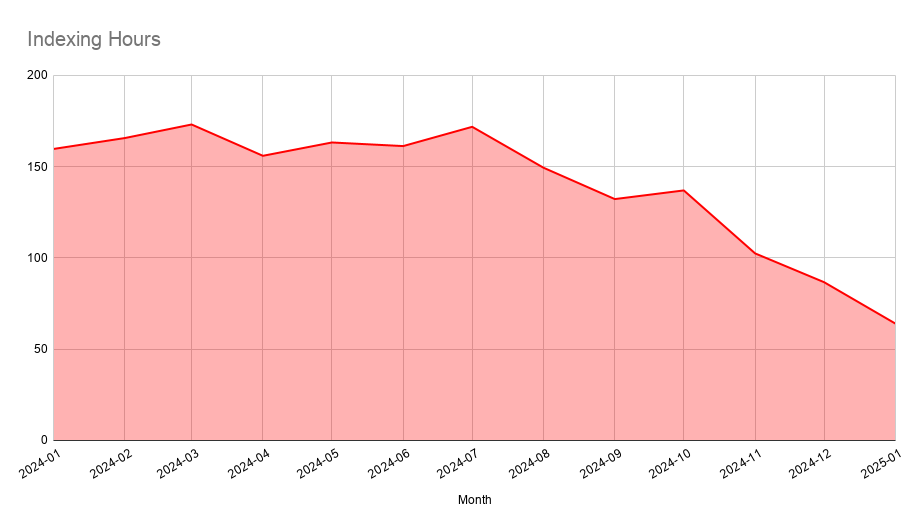
- January 2024 — Manual indexing
- August 2024 — IDA semi-automated mode enabled
- October 2024 — IDA fully automated mode enabled
How IDA Works
IDA fits directly into DataCare’s medical management workflows.
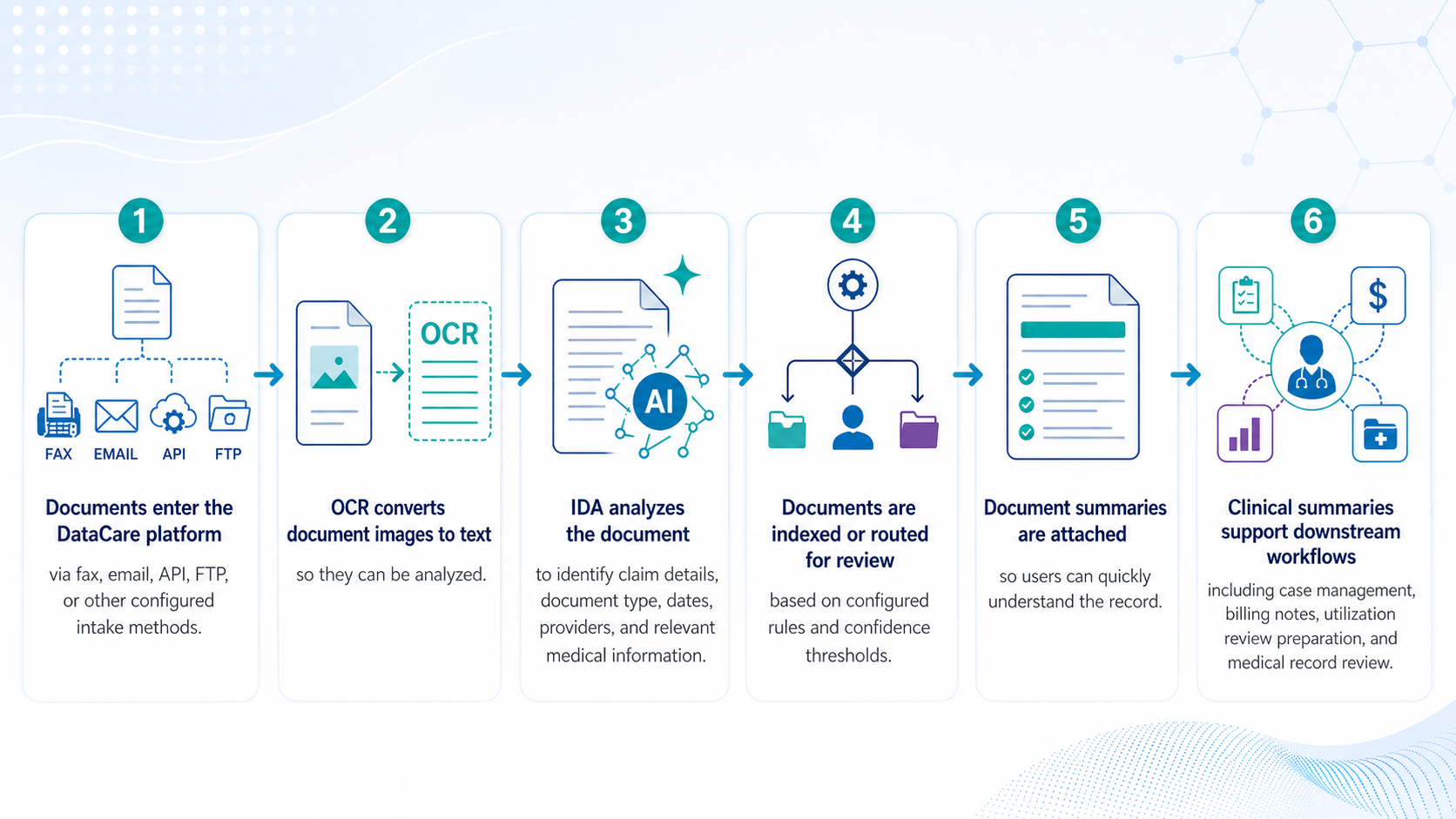
IDA can be used as part of DataCare’s case management and utilization review workflows, or as a standalone document automation product integrated with existing systems.
AI Automation With Human Oversight
Unlike standard AI tools, IDA is customizable to your organization’s systems and document management needs. This “hybrid intelligence” approach delivers the best of both worlds: automation you can trust, with built-in safeguards to maintain quality and compliance.
Ready to Transform Medical Document Processing?
Stop wasting time on outdated, manual document processes.
With DataCare IDA, your organization can reduce indexing effort, summarize medical records faster, support utilization review preparation, and turn incoming documents into actionable medical management information.
Book a demo today and see how IDA can streamline your medical document indexing, summaries, review workflows, and document management.